
Elementary Curriculum
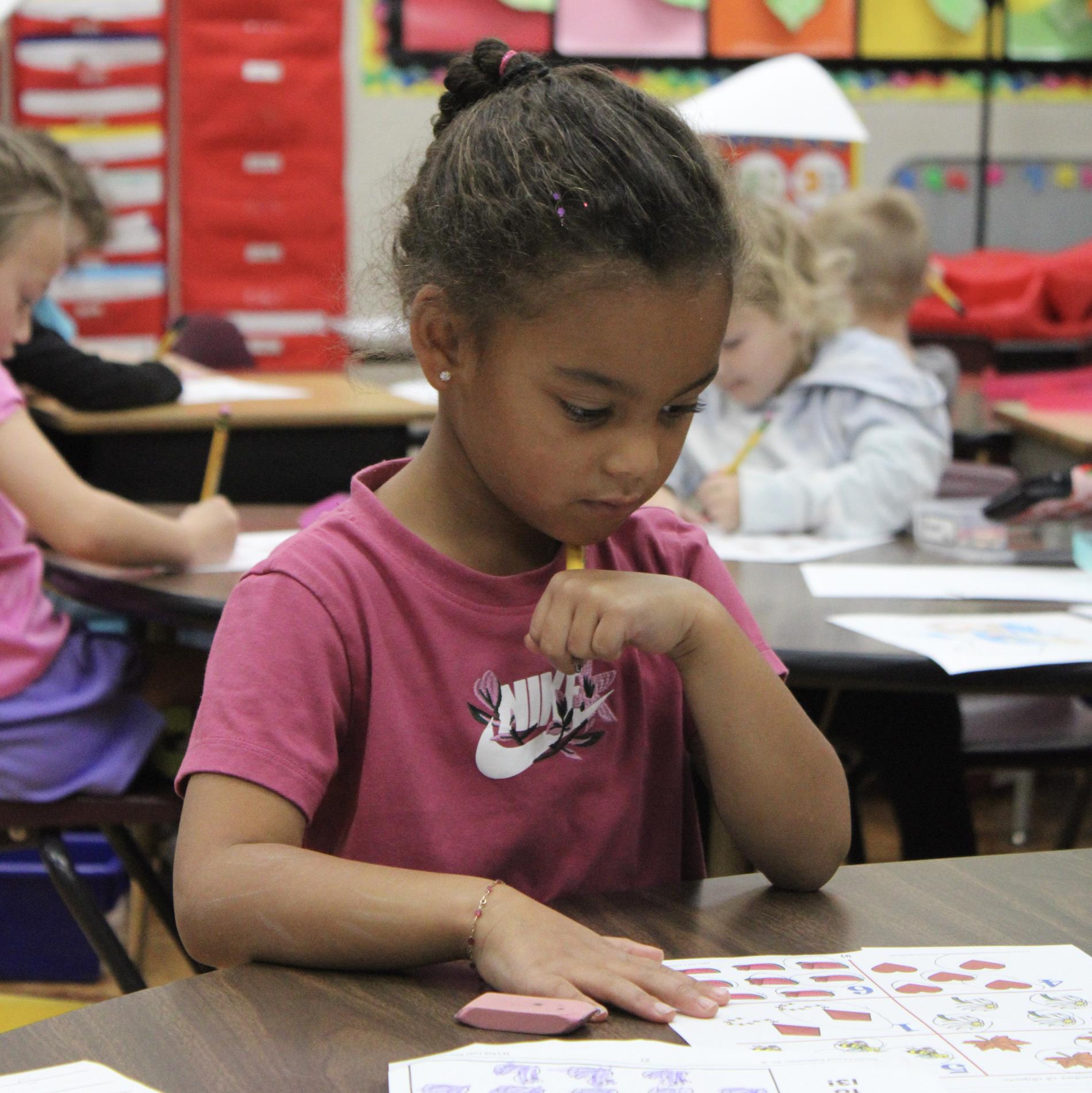


We believe all students are equipped with God given gifts and we provide opportunities for our students to discover their potential, develop skills with confidence, and compete in a variety of academic contests, such as math, art, speech, choir, band and athletics.
Grade Level Curriculum
Specials/Enrichment
Library, Spanish, Art, Music, PE
Bible Class (Abeka)
Students will learn about God and His Son, Jesus. Selected Old and New Testament stories are presented along with holiday stories teach the events surrounding the first Thanksgiving, the birth of Christ, and the resurrection. Students will also learn 26 memory verses and songs.
Reading & Phonics (Abeka)
This program uses a logical phonics system to help the students find success immediately so the student can quickly become an independent reader. They will learn the following: alphabet and its sounds, long and short vowels, intro to diagraphs, sight words, and basic narrative skills.
Math/Numbers (Abeka)
Students will develop number sense by recognizing and understanding basic number concepts. They will learn to count from 1 to 100, recognize and write numbers 1–20, and identify before and after numbers, as well as more and less, and the largest and smallest. Instruction also includes shapes, days of the week, months, seasons, calendar skills, and basic measurements. Students will begin solving simple addition and subtraction combinations.
Science (hands-on learning)
Students will explore basic science concepts such as chemical reactions, weight and measurement, and color combinations. These skills are introduced through hands-on activities including cooking experiences, water play, and paint manipulation. Students will also learn about the gestational life cycle of a chicken and will plant and care for growing plants in our outdoor garden.
Social Studies (thematic and seasonal)
Students will explore a new state each week, learning about its location and a major attraction. The study begins with their home state of Oklahoma and continues throughout the year as they discover other states across the country.
Penmanship (Abeka)
Students will learn proper writing posture and the correct way to hold a pencil. They will practice writing all 26 uppercase and lowercase letters, blending letters into one-vowel words, name and, when ready, writing their birthday, and address.
For details on the Abeka curriculum, you can view their Scope and Sequence here.
Specials/Enrichment
Library, Spanish, Art, Music, PE
Bible Class (Abeka)
Students will learn about God and His Son, Jesus. Selected Old and New Testament stories are presented along with holiday stories teach the events surrounding the first Thanksgiving, the birth of Christ, and the resurrection. Students will also learn 26 memory verses and songs.
Reading, Phonics and Language (Abeka)
This program uses a logical phonics system designed to help students experience immediate success and quickly become independent readers. Students will learn 21 consonants and their sounds, the five vowels, and how to blend consonants and vowels together. Instruction includes sounding out one- and two-vowel words, learning phonics rules, special sounds and clue words, sight words, and reading simple sentences and stories. Basic Phonics Readers will introduce reading comprehension, while writing instruction focuses on using capital letters, punctuation, and constructing simple sentences.
Math/Numbers (Abeka)
Students will reinforce number concepts and formation through 100, addition and subtraction combinations, number sequences, number words, telling time, and working with money. They will recognize, write and understand concepts 1 – 100, count by tens, fives, and twos to 100, understand and write subtraction sentences from numbers 1 – 10, learn parts of a whole and half, solve story problems, read and write time, and measurements.
Science (Abeka and hands-on learning)
Students will be introduced to God’s plan for the universe through exploration of His creation. Units include the five senses, health and the human body, weather, seasons, seeds and plants, animals, and the seashore. Each topic highlights the amazing wonders of God’s design in the world He created.
Social Studies (Abeka and thematic and seasonal)
Students will be introduced to community helpers, the beginnings of American history, notable historical figures, and important American landmarks. They will also explore geography through globe studies, learning about directions, neighboring countries, the seven continents, the four oceans, and interesting features of 12 countries around the world. Instruction also includes basic geography concepts to help students understand the world around them.
Penmanship (Abeka)
Students will learn to write the letters that are correlated with the phonics program. The “houses” help students remember where each letter “lives.” Students will write letters, blends, words, and sentences.
For details on the Abeka curriculum, you can view their Scope and Sequence here.
Specials/Enrichment
Library, Spanish, Art, Music & PE class
Bible Class (Abeka)
Students will learn about God and His Son, Jesus. Selected Old and New Testament stories are presented along with holiday stories teach the events surrounding the first Thanksgiving, the birth of Christ, and the resurrection. Students will also learn 26 memory verses and songs.
Reading, Phonics and Language (Abeka and MacMillan-Lippincott Basic Reading)
This program uses a logical phonics system to build strong reading skills. Students will learn and apply 85 additional special sounds and diagraphs, along with corresponding clue words. They will develop an understanding of syllables and learn to identify root words, suffixes, and prefixes. Instruction also emphasizes comprehension skills and guided discussion. In Language Arts, students will study compound words, synonyms, homonyms, contractions, possessives, plurals, verb tenses, and subject–verb agreement. They will practice comprehension and learn to write engaging sentences, paragraphs, and short narratives. By the end of the year, students will read Aesop’s Fables, The Courage of Sarah Noble, and Little House in the Big Woods.
Math (Abeka)
Students will reinforce number concepts and number formation up to 1,000. They will work with odd and even numbers, compare numbers using greater than and less than, and develop an understanding of place value through the hundreds. Instruction includes addition with carrying up to three-digit numbers, subtraction families 1–18, and subtracting up to three-digit numbers without borrowing. Students will also be introduced to the concepts of multiplication and fractions. They will practice solving story problems and applying math skills to real-life situations involving money, temperature, time, graphs, calendars, measurements, geometry, and maps.
Science (BJU Press)
The lessons engage students in biblical worldview formation by exploring foundational questions such as: Where did our world come from? Why do things work together the way they do? Where are we, and why are we here? and Why is Science Important? Students will address these questions through inquiry-based investigations, hands-on explorations, and STEM activities. Content areas include General Science, Physical Science, and Life Science—covering ecosystems, plants, animals, and the human body—as well as Earth and Space Science.
Social Studies
Students will learn the chain of History starting with creation, Moses, Jesus, Paul, Bible, Columbus, patriots and end with pioneers.
Penmanship (Abeka)
Students will learn to write the letters that are correlated with the phonics program. The “houses” help students remember where each letter “lives.” Students will write letters, words, and sentences.
Spelling (Abeka)
Students spelling lists will match their phonics words and rules along with sight words.
For details on the Abeka curriculum, you can view their Scope and Sequence here and for BJU Press, their Scope and Sequence is available here.
Specials/Enrichment
Library, Spanish, Art, Music & PE class
Bible Class (BJU Press)
Bible Truths – A Servant’s Heart integrates doctrine into a chronological and thematic study of the Old and New Testaments. Students will learn about Bible characters such as Noah, Abraham, Gideon, Samson, Nehemiah, Ruth, Esther, Daniel, Dorcas, Paul, and Jesus. Students will also memorize weekly Bible verses or passages to reinforce their learning.
Reading (BJU Press)
In reading, students will continue developing phonemic awareness, decoding skills, word recognition, background knowledge, vocabulary, literature skills, and comprehension. By the end of the year, students will read Charlotte’s Web and Farmer Boy using novel unit literature guides. These guides support improved comprehension, vocabulary, and critical thinking, and a deeper analysis of literary elements such as character, theme, and figurative language.
Language Arts and Writing (Abeka)
Language concepts are expanded as students learn to apply key skills, including recognizing and correctly punctuating four types of sentences; identifying and using nouns, verbs, adjectives, and adverbs; and identifying the subject and predicate of a sentence. Students will also work with compound words, rhyming words, antonyms, synonyms, contractions, and singular possessive forms. The creative writing process is incorporated, with a focus on structured opinions, explanatory and narrative writing through the Paragraph of the Week program.
Math (Abeka)
Students will learn to apply mathematical concepts to real-life situations. Instruction covers place value, addition (up to 5 digits with carrying) and subtraction (up to 4 digits with borrowing), money, time, graphs, and geometry. Students will also study multiplication and division, fractions, decimals, problem solving, Roman numerals, measurements, graphing, statistics, and probability.
Science (BJU Press)
The lessons engage students in biblical worldview formation by exploring foundational questions such as: Where did our world come from? Why do things work together the way they do? and Why are we here? Students explore these questions through inquiry-based investigations, hands-on explorations, and STEM activities. Content areas include General Science, Physical Science, and Life Science as well as Earth and Space Science.
Social Studies (BJU Press)
In Community and Government, students will develop a biblical worldview of communities, government, commerce, people, places, and American culture. They will learn about influential figures such as Norman Rockwell, Jonathan Edwards, John Adams, Abigail Adams, George Washington Carver, Henry Ford, Daniel Boone, Sacagawea, Jackie Robinson, and Alexander Graham Bell. Instruction also covers the history of the Constitution, as well as geography, government, and economics.
Penmanship (A Reason for Handwriting)
Students will review manuscript letters and transition to cursive writing during the second semester. Instruction begins with lowercase and uppercase letters, then progresses to writing words and Scripture passages.
Spelling (A Reason for Spelling)
This comprehensive curriculum combines the latest research on how children learn to spell, with all the strengths of traditional programs and phonics. All word lists are based on frequency of use in student and adult writing; frequency of use in reading materials; spelling difficulty; and grade level familiarity.
For details on the Abeka curriculum, you can view their Scope and Sequence here, and for BJU Press, their Scope and Sequence is available here.
Specials/Enrichment
Library, Spanish, Art, Music, PE class, and Computer class
Bible Class (BJU Press)
Bible Truths – Follow Christ integrates doctrine into a chronological and thematic study of the Old and New Testaments. Students will learn about Bible characters such as Cain, Abel, Seth, Job, Lot’s wife, Korah, Elijah, Jesus, the apostles, Peter, Philip, and Paul. Key themes include sin and salvation, purity, the life of Christ, willingness, friendships, and obedience to authorities. Students will also memorize weekly Bible verses or passages to reinforce their learning.
Reading (BJU Press)
In reading students will read Abeka readers – Footprints and Crossroads, Secret in the Maple Tree, Pilgrim Boy, Pilgrim’s Progress, Abigail Adams, and Little House on the Prairie. Novel unit literature guides are used to improve comprehension, vocabulary, and critical thinking by allowing for deeper analysis of literary elements like character, theme, and figurative language.
Language Arts and Writing(Abeka)
Students will expand their language skills by learning to write and correctly punctuate four types of sentences. They will identify and correctly use nouns, verbs, adjectives, adverbs, pronouns, and conjunctions, and analyze sentences to identify subjects and predicates, including compound subjects and verbs. Instruction also covers subject-verb agreement with simple and compound subjects and verbs, contractions, and irregular verbs. Students will work with rhyming words, antonyms, synonyms, homonyms, contractions, and singular possessive forms, as well as forming plural nouns and singular verbs using spelling rules. The creative writing process is incorporated through the Paragraph of the Week program, focusing on structured opinion, explanatory, and narrative writing.
Math (Abeka)
Students will learn to apply mathematical concepts to real-life situations. Instruction includes reviewing addition and subtraction, learning multiplication tables 0–12, multiplying with two-digit multipliers, dividing with up to two-digit divisors, and solving multi-step story problems. Students will also study fractions, equations, decimals, problem solving and applications, time, money, measurement conversions, graphs, statistics, probability, geometry, and introductory pre-algebra.
Science (BJU Press)
The lessons engage students in a biblical worldview formation in General Science, Physical Science: matter, energy and motion, and waves; Life Science: ecosystems, plants, animals, the human body; Earth and Space Science: the geosphere, the atmosphere, and the cosmos, and Engineering Design: STEM activities.
Social Studies (BJU Press)
In World Regions, students will develop a biblical perspective of geography and social studies skills while exploring culture, religions, and beliefs, including the spread of Christianity throughout different regions of the world. Instruction also covers world exploration and migration, global geography, various types of maps, government, and economics.
Penmanship (A Reason for Handwriting)
Students will continue mastering their cursive using a traditional, Scripture-focused curriculum.
Spelling (A Reason for Spelling)
This comprehensive curriculum combines the latest research on how children learn to spell, with all the strengths of traditional programs and phonics. All word lists are based on frequency of use in student and adult writing; frequency of use in reading materials; spelling difficulty; and grade level familiarity.
For details on the Abeka curriculum, you can view their Scope and Sequence here and for BJU Press, their Scope and Sequence is available here.
Specials/Enrichment
Library, Spanish, Art, Music, PE class, and Computer class
Bible Class (BJU Press)
The Pathway of Promise is a chronological study of the Old Testament that emphasizes understanding the Bible as one unified story with three progressive parts: Creation, Fall, and Redemption. Students will learn about Bible characters such as Noah, Abraham, Moses, and David, as well as the New Covenants. The curriculum focuses on developing skills in reading Scripture and allowing the Bible to answer important questions. Students will also memorize weekly Bible verses or passages to reinforce their learning.
Reading (BJU Press)
In reading students will read Song of the Brook, Stone Fox, The Best Christmas Pageant Ever, and On the Banks of Plum Creek. Novel unit literature guides are used to improve comprehension, vocabulary, and critical thinking by allowing for deeper analysis of literary elements like character, theme, and figurative language.
Language Arts and Writing (Abeka)
Students will expand their understanding and knowledge of English by applying key concepts such as sentence structure and writing style. They will identify and correctly use all eight parts of speech, including action, helping, being, and linking verbs, and analyzing sentence patterns. Instruction covers subject-verb agreement, including contractions and irregular verbs, punctuation rules, capitalization rules, and proofreader’s marks. The creative writing process is incorporated through the Paragraph of the Week program, with a focus on opinion, explanatory, and narrative writing.
Math (Abeka)
Students will expand their math skills to include multiplying and dividing multi-digit numbers, estimation, interpreting graphed data, writing decimals as fractions, and basic geometry. A major emphasis is placed on working with proper and improper fractions, including adding, subtracting, and multiplying fractions, as well as finding the least common denominator. Students will continue to solve multi-step word problems that encourage practical application.
Science (BJU Press)
The lessons engage students in worldview formation in General Science, Physical Science: energy and motion, waves; Life Science: plants, animals, the human body; Earth and Space Science: the geosphere, the hydrosphere; and Engineering Design: STEM activities.
Social Studies (BJU Press)
In Heritage Studies, students will develop a biblical worldview through the study of American history. They will learn geography and map skills, including the fifty states, and explore key historical events such as World War I and II, and American history from the Native Americans to the War of 1812. Instruction also covers government, including the branches, voting, and citizenship, as well as economics. Students will spend a quarter focusing on Oklahoma state history, including a re-enactment of the Oklahoma Land Run and a special lesson from a guest speaker about the Native Americans of Oklahoma.
Penmanship (A Reason for Handwriting)
Students will continue mastering their cursive using a traditional, Scripture-focused curriculum.
Spelling (A Reason for Spelling)
A comprehensive curriculum combines the latest research on how children learn to spell, with all the strengths of traditional programs and phonics. All word lists are based on frequency of use in student and adult writing; frequency of use in reading materials; spelling difficulty; and grade level familiarity.
For details on the Abeka curriculum, you can view their Scope and Sequence here and for BJU Press, their Scope and Sequence is available here.
Specials/Enrichment
Library, Spanish, Art, Music, PE class, and Computer class
Bible Class (BJU Press)
The Fullness of Time is a chronological study of the New Testament, with Christ as the central figure and culmination of the Bible’s major themes. Students will integrate doctrine into a study of the Creation–Fall–Redemption metanarrative as it unfolds in the New Testament. Weekly Bible verses or passages are memorized to reinforce understanding and application.
Reading (BJU Press)
In reading, students will explore novels such as Noah Webster; The Lion, the Witch, and the Wardrobe; Number the Stars; and The Door in the Wall. Novel unit literature guides are used to enhance comprehension, vocabulary, and critical thinking, allowing students to engage in deeper analysis of literary elements such as character, theme, and figurative language.
Language (Abeka)
God’s Gift of Languagedeepens students’ knowledge of grammar while strengthening their writing skills. Students will be introduced to the four main types of complements and additional punctuation rules and will learn to diagram prepositional phrases and complements. Writing instruction focuses on developing effective topic sentences and paragraphs, as well as using transitional words to improve flow. Skills in outlining, note-taking, and preparing a bibliography will support students in writing an encyclopedia report and a library research report. The creative writing process for opinion, explanatory and narrative writing is incorporated through the Paragraph of the Week program.
Math (Abeka)
Arithmetic 5 features an abundant practice of new and review concepts, and daily word problems to reinforce learning. Problem-solving strategies are integrated throughout the text to help students develop the skills necessary to become proficient problem solvers. Emphasis is placed on topics such as addition, subtraction, multiplication, division, fractions, decimals, measurement, algebraic equations, percent, ratio and proportion, graphing, statistics, probability, and basic geometry.
Science (BJU Press)
The lessons engage students in biblical worldview formation through the study of science. Content areas include General Science; Physical Science, focusing on matter; Life Science, covering ecosystems and the human body; and Earth and Space Science, exploring the geosphere, atmosphere, and cosmos. Students explore these topics through hands-on experiments, investigations, and STEM projects that highlight God’s design in creation.
Social Studies (BJU Press)
In Heritage Studies, students will develop a biblical worldview through the study of American history from 500 B.C. to the 2010s. They will explore a biblical perspective on equality, freedom, justice, and religion, while also examining culture and language, including comparisons of Native American tribes, the civil rights movement, the Gilded Age, the rise of counterculture, and contemporary issues. Historical events covered include pre-Columbus exploration, the Great Awakening, the French and Indian War, the Revolutionary War, the War of 1812, the Civil War, the Emancipation Proclamation, World War I, the Great Depression, World War II, the Korean War, the Space Race, the Civil Rights Movement, the Vietnam War, Operation Desert Storm, 9/11, the War in Iraq, and Hurricane Katrina. Geography, government, and economics are integrated throughout the curriculum
Spelling (A Reason for Spelling)
A comprehensive curriculum combines the latest research on how children learn to spell, with all the strengths of traditional programs and phonics. All word lists are based on frequency of use in student and adult writing; frequency of use in reading materials; spelling difficulty; and grade level familiarity.
For details on the Abeka curriculum, you can view their Scope and Sequence here and for BJU Press, their Scope and Sequence is available here.